Anonymous Online Sharing
Lowers the emotional barrier to sharing, but the isolation persists.
Permission to speak, not more information to learn alone.
A board game where women learn and talk about sexual and reproductive health together, without shame or judgment.
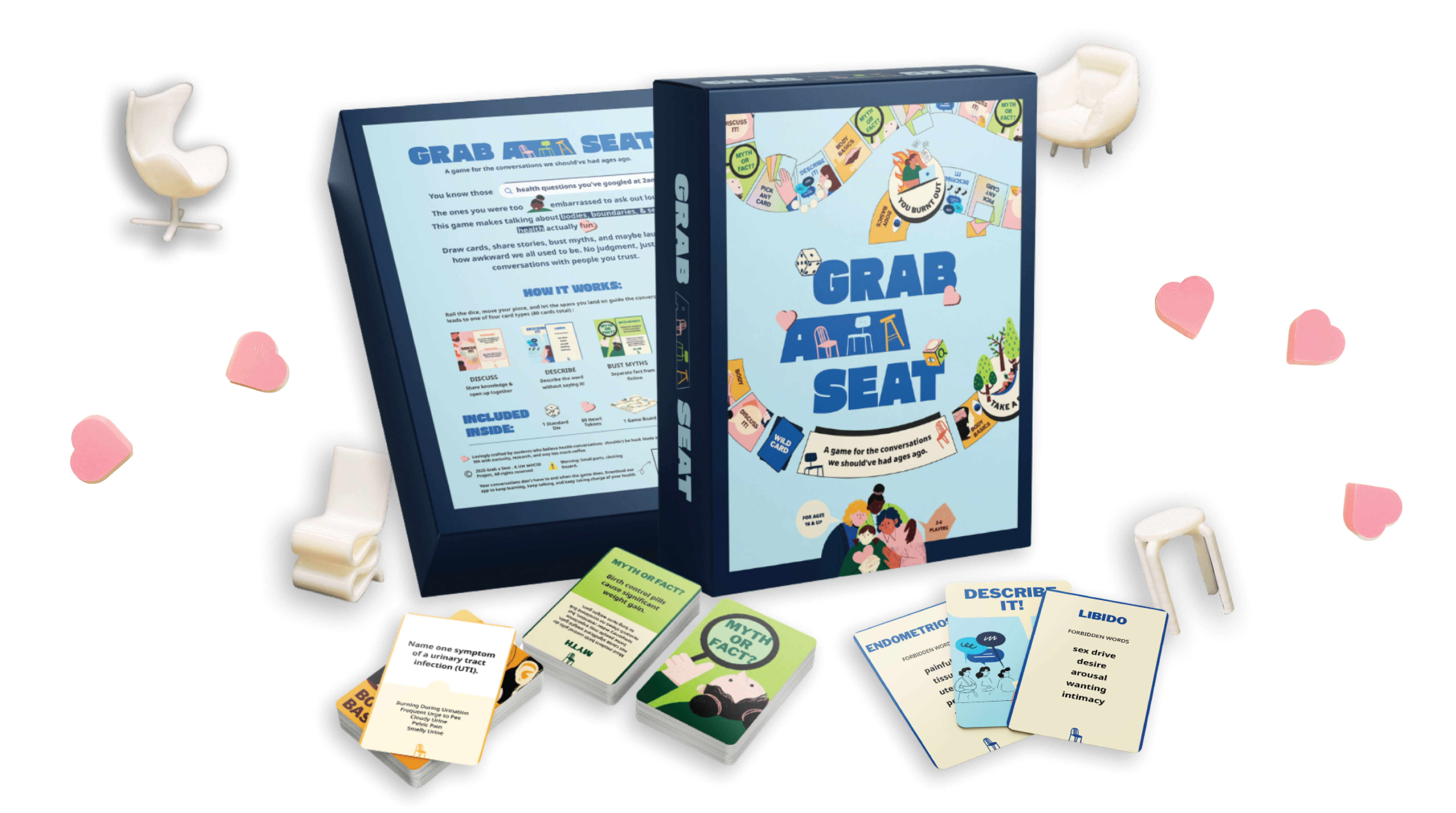
Most women learn about periods, contraception, and their own symptoms from the internet at 2am, because saying the words to another person feels too risky. Grab a Seat is a board game that makes saying them possible.
I owned research, game mechanics and content, four rounds of playtesting, and physical production.
Four of us, different cultures and religions, and every one of us learned about our bodies from midnight Google searches. Lived experience is a hypothesis. Intuition is not evidence. So we tested it.
“In my culture, women’s health wasn’t talked about, only whispered, so I grew up believing these topics were too shameful to talk about.” - Team Member
The stakes are highest where the literacy is lowest. Young adults ages 15 to 24 are about a quarter of the sexually active population and account for nearly half of new STIs. For women from cultures where the topic is taboo, the gap compounds: stigma, family silence, and language barriers keep the question from being asked at all.
We designed for them: young women, 14 and up, especially from communities where these conversations are off-limits, met in rooms where they already gather. Friend groups, classrooms, clinics, families.
Through surveys and interviews, we discovered our experiences were universal. Every woman felt hesitant discussing sexual health, and relied primarily on the internet for health advice. Yet, all expressed deep desire for safe spaces to learn without judgment.
When something feels off with your reproductive health, who do you speak to first?
“There just wasn’t ever really a safe space of, like, if you ever need anything, you can come to me. So my most reliable resources were always the internet or other women my age.”
- P5
So we stopped designing for information, and started designing an experience that cultivates conversation.
A social problem needs a social setting.
We evaluated four directions before choosing the medium.
Lowers the emotional barrier to sharing, but the isolation persists.
Information at the moment of need, but no dialogue.
Relies on trust already existing in the relationship.
Puts people in a room together and lowers the stakes of speaking.
The first three put learning back on one person and one screen. The game used play as a social lubricant to establish connection.
Heavy topics in a lightweight form.
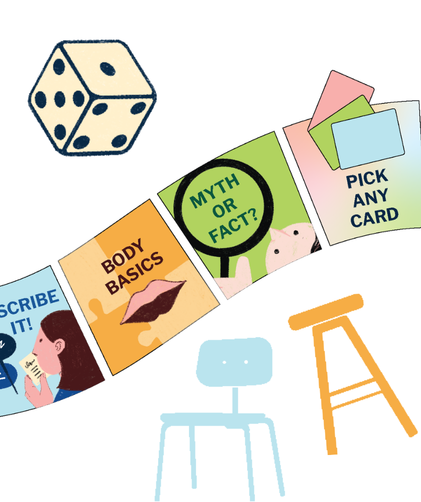
Four card families with gamified prompts that increase in emotional cost and a dice roll to choose, which gives everyone a chance to answer.
Click to flip
Build vocabulary before a crisis forces it
Correct misinformation without humiliating anyone
Practice describing bodies and symptoms
Host honesty without requiring confession
After four rounds of playtesting with 24+ players, each round revealed a mechanic quietly raising the cost of speaking.
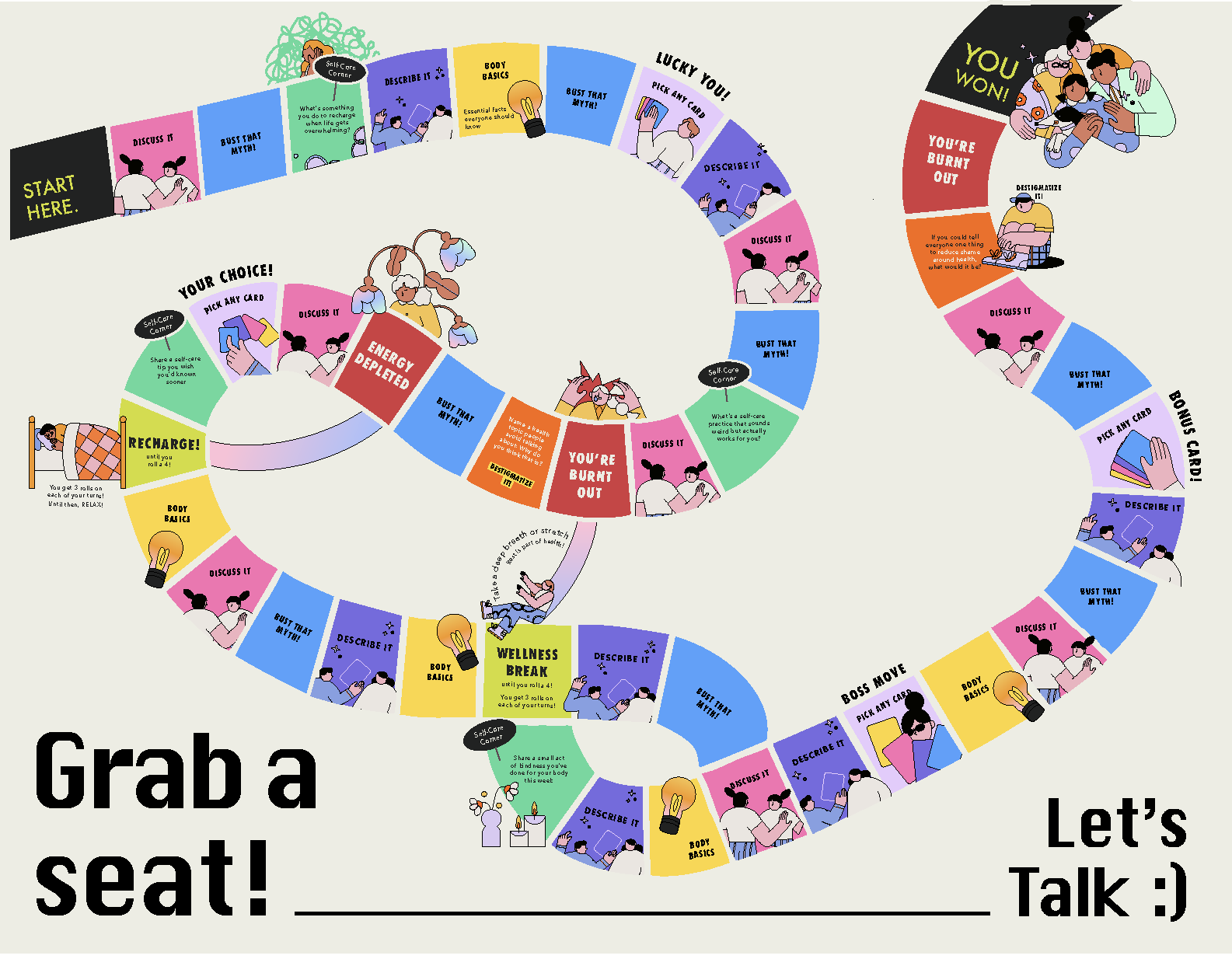
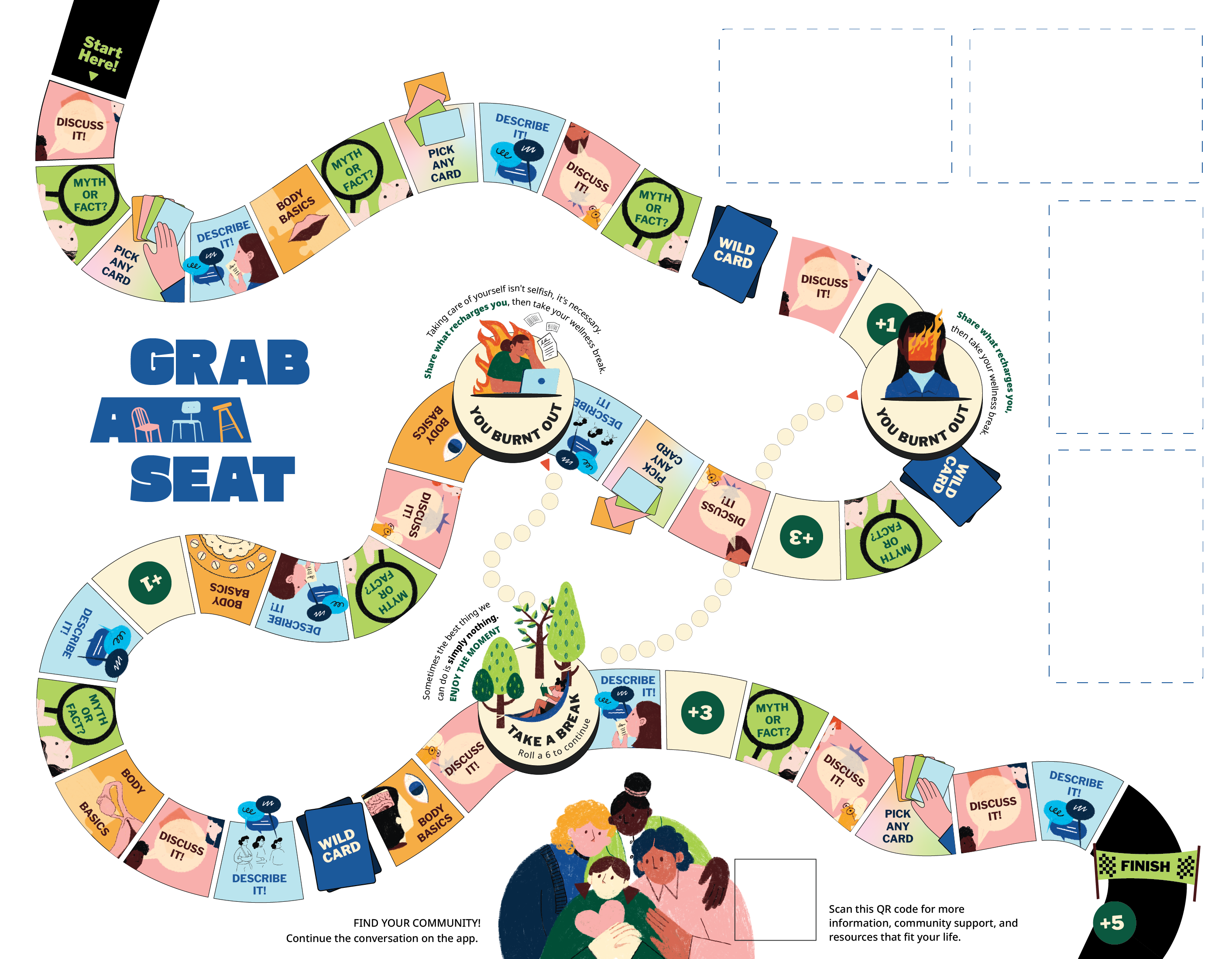
Confusing mechanics stalled play, and you couldn’t advance without answering a card. We simplified the rules and removed the penalty. Passing became free.
Prompts that addressed the player directly, “Your pap smear came back positive,” made people deflect under the pressure to disclose. Every card was reframed to remove the pressure, “a friend’s pap smear,” and the same questions got answered instead of passed.
Hearts went to the first correct answer, rewarding whoever already knew the most. Hearts became rewards for participation: speaking up, not knowing.
A full game lasted nearly 45 minutes and players wanted to play shorter versions they could take with them. We built Quick Play and Cards Only.
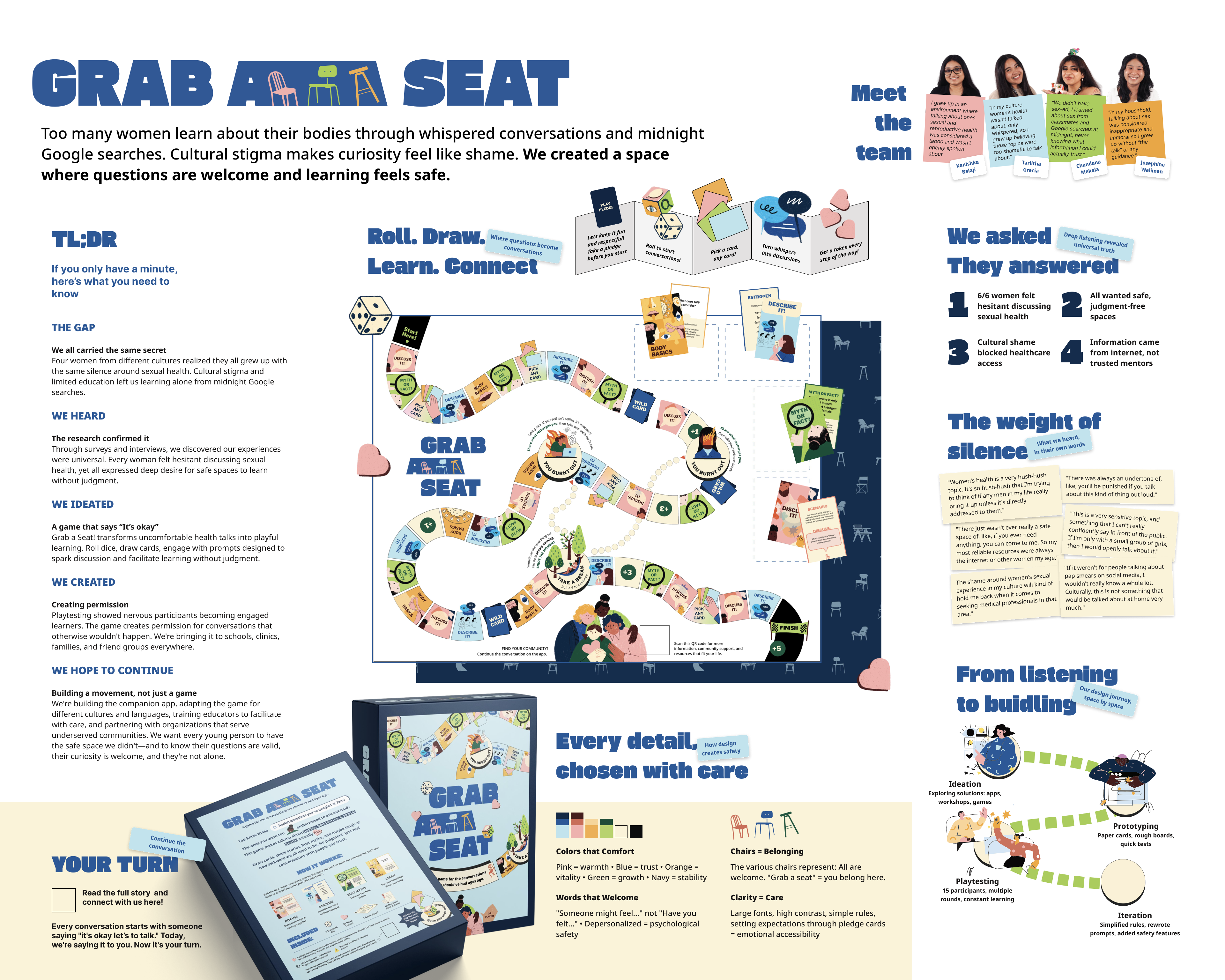
Four playtest rounds, more than 24 participants, across ages, cultures, and comfort levels, including people who would run this in the wild: educators, parents, and healthcare facilitators. Hesitant players were laughing and sharing within roughly seven minutes. Participants told us, unprompted, that these conversations would not have happened anywhere else.
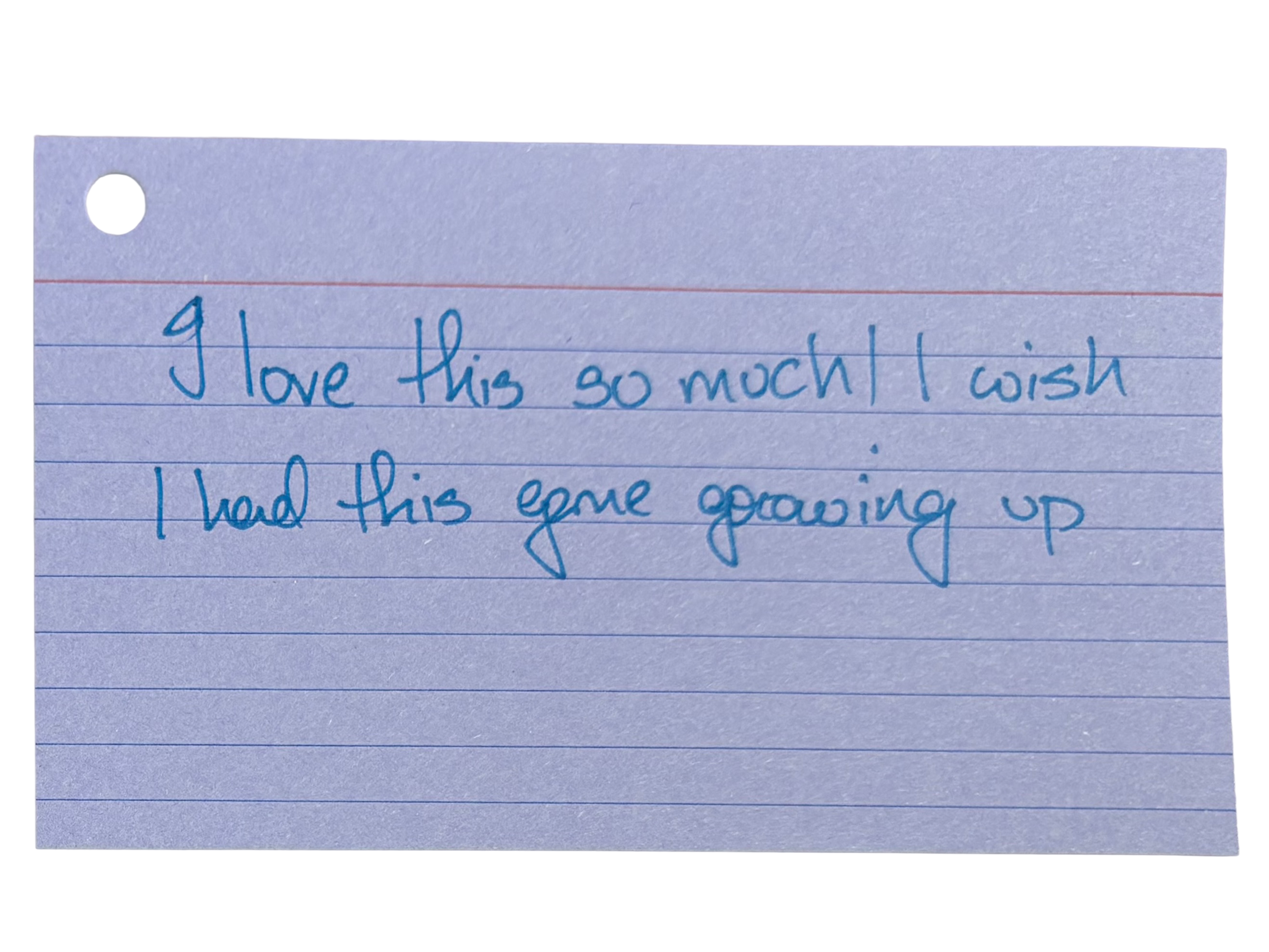
Grab a Seat does not fix the system. It builds the room where a first conversation becomes possible.
Design the conditions before the content.
Sensitive topics need a conversational microenvironment: a pledge, shared rules, rising emotional cost, and a reward for speaking. Trust was scaffolded in the first minutes so the hard cards could land later.
Turn values into testable mechanics.
Emotional safety only became real when it showed up as pieces, copy, and incentives. Playtesting made each change falsifiable: what broke, what we changed, what the table did next.
The medium matters as much as the message.
The most impactful solutions are not always the most innovative. Choosing a physical, social format over a digital one was not the obvious move. It made shared connection possible where an app would have deepened the isolation.