24 Playtesting participants
Across four rounds
Qualitative research · Game mechanics · Digital fabrication
MHCI+D · HCID 511 · Nov–Dec 2025
Infrastructure for a conversational microenvironment about women’s sexual and reproductive health — built as a physical board game so the first honest sentence can happen in the room, not alone on a screen.
Skip to card families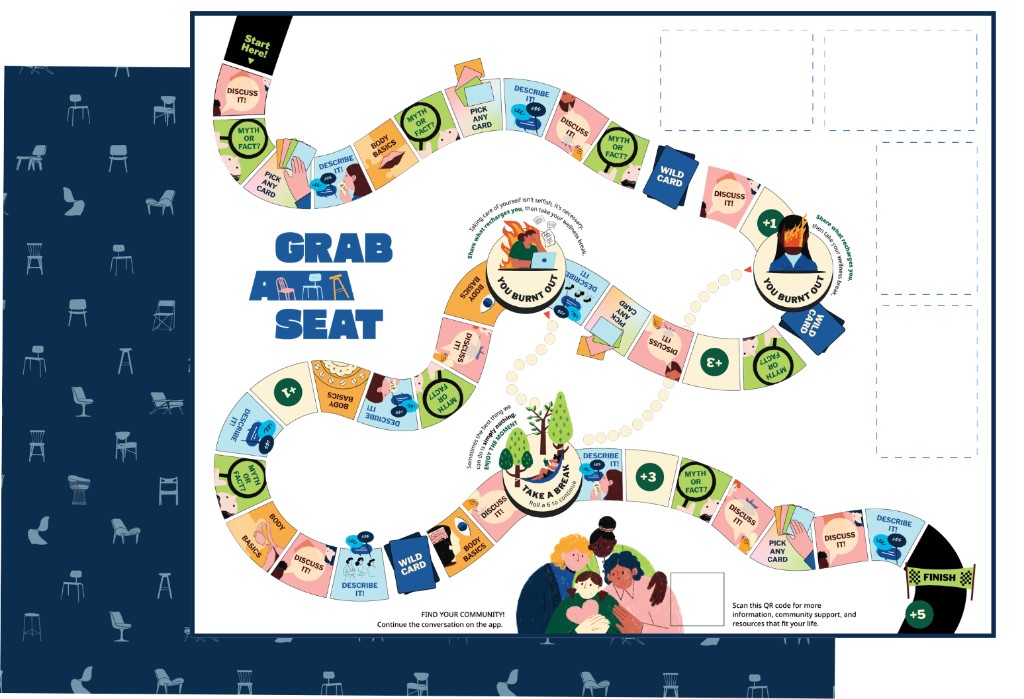
24 Playtesting participants
Across four rounds
20 Research participants
14 survey · 6 interviews
Physical deliverables
Board · four card families · 3D-printed pieces · Play Pledge card
Sexual and reproductive health is actively silenced across cultures. Young women navigate consequential decisions through whisper networks and private screens rather than clinical relationships. The gap isn’t knowledge — it’s trust. In institutions. In family rooms. In their own right to ask without penalty.
The ecosystem responds reactively: unintended pregnancy, STIs, dismissed pain, unwanted sex — each outcome treated while the upstream silence stays intact. Prevention and education deserve innovation too. This project begins where silence starts.
All four team members carried lived experience of silence around women’s health. Pattern recognition isn’t evidence. We needed to know whether what we’d lived was bigger than our backgrounds — and which mechanisms kept silence in place so we could design against structure, not vibes.
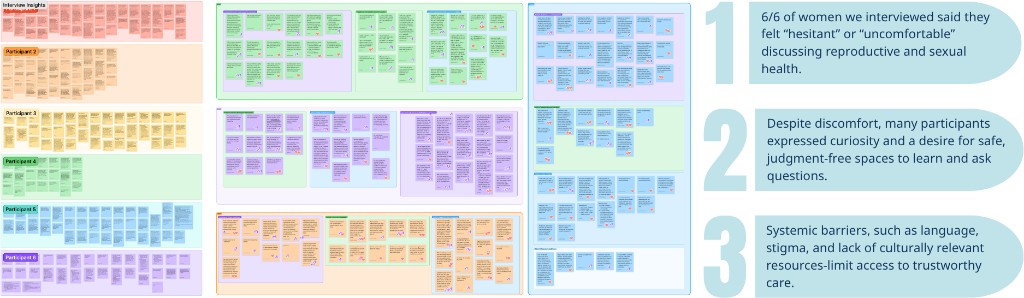
Fourteen survey responses and six interviews with women 18–40 who grew up where women’s health was taboo, recruited across backgrounds to separate cultural variation from shared patterns. I led facilitation, question design, and the consent protocol — for sensitive work, the protocol is the product.
100%
Turn to the internet first — not clinicians, not family
92.9%
Rarely or never discussed sexual health at home growing up
64.3%
Do not know who to trust for health information
Three findings drove the system: silence is systematic (shame, secrecy, and self-directed learning appeared across every background); systems trained avoidance (participants learned not to bring their full selves into clinical spaces through dismissal and minimized pain); and the hunger is for a safe room, not a bigger PDF.
We pressure-tested four directions: an anonymous digital storytelling platform, myth-busting card inserts, a parent–child structured conversation toolkit, and card-forward board play. Digital formats kept sliding toward learning alone — the failure mode we were trying to break. Participants also described distrust of digital health tools after privacy breaches.
Board play won because it lowers the cost of the first sentence. It trades correctness for participation. It keeps bodies co-present in the same ritual. When you’re playing, you’re not intruding — you’re participating.
A game-based teaching group showed greater improvement in learning outcomes and engagement than a traditional lecture group covering identical content. (Hu et al., 2021)
A physical game isn’t a compromise — it’s the format with the highest probability of producing the first honest conversation between people who might otherwise never begin.
We committed to a physical board game — not a single-symptom intervention but a versatile social experience adaptable across dorms, clinics, classrooms, and friend groups. Safety had to be structural, not tonal.
Grab a Seat converts awkward topics into structured play through four card families, a reward-based movement system, and an explicit Play Pledge that makes permission to participate a shared ritual rather than an individual risk.
| Card family | Design intent |
|---|---|
| Myth or Fact | Name misinformation without humiliating whoever believed it. On the board path: “Bust That Myth!” |
| Body Basics | Build vocabulary before crisis forces it. Cover foundational gaps formal education skipped. |
| Describe It | Practice describing bodies and symptoms at low stakes — in language and across languages. |
| Discuss It | Host honesty without requiring confession. Strategic distance makes the first sentence possible. |
One export shows how each family frames the prompt on the front and carries the conversation on the back.
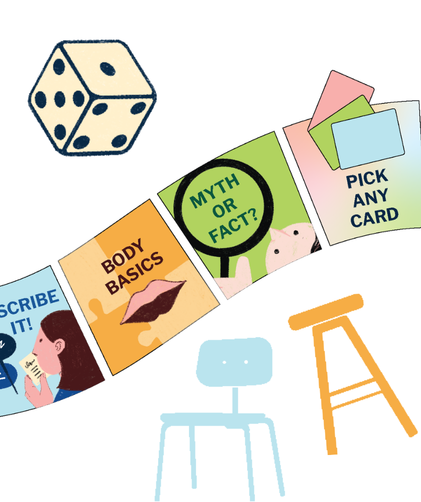
Movement borrows from Monopoly and Chutes & Ladders. Engagement borrows from Taboo and Monikers — description-driven, social, loud enough to fill a room. The Play Pledge is read aloud before the first draw. Safety is structural, not tonal.
The failure mode was obvious: generic health trivia that reads like mandatory sex ed. We built content from interview transcripts and the affinity map — each card family maps to a specific research pattern, not a syllabus assumption.
Myth or Fact cards address the misinformation ecosystems participants described — TikTok health advice, outdated curricula, foundational concepts taught without consent vocabulary. Body Basics fills in the gaps whole cohorts missed entirely. Describe It gives people language to name what they experience before crisis forces them to find it. Discuss It hosts honesty without demanding performance of vulnerability.
On the board, myth prompts surface as “Bust That Myth!” — same job, legible at a glance on the path. The board’s language meets people where culture already meets them, while the card content stays grounded in what research identified as the actual gaps.
The first complete prototype worked mechanically, not emotionally. Players leaned into Myth or Fact and Body Basics, then stalled on Discuss It: read, pause, deflect, pass. The topic wasn’t too hard. The framing was.
Discuss It prompts asked for first-person confession — “Have you ever…”, “Share a story about a time when…” — which registers as performance, not conversation, with loose ties around a table. This is a structural problem, not an ambition problem.
“Have you ever…” / “Share a story about a time when…” — first-person confession framing
Third-person strategic distance — “Someone might…” / “What would you tell a friend who…” — conversation, not performance.
Strategic distance lowers the emotional cost of the first sentence without reducing the depth of what follows. It’s an invitation, not a demand.
Additional structural moves: penalties out, tokens and extra turns for showing up rather than for being right; four primaries and two neutrals for a readable, calm visual system; distinct chair silhouettes — not identical pieces in different colors — so the components argue for inclusion before anyone draws a card.
After the structural edits, deflection turned into disclosure. Sometimes stories participants said they had never said aloud. Twenty-four participants across four rounds — mixed familiarity, age, and comfort. Within roughly fifteen minutes, hesitant groups were laughing and asking real questions.
The game was built to be replicable: standard card sizes, vinyl board fabrication, 3D-printed pieces designed for batch production. The physical design disappears when not in use — a board that can sit flat on a table without dominating it, pieces that pack down to a small box.
The adaptability is the scale story. Grab a Seat works in a dorm room or a clinic waiting room, in a friend group or a classroom. It doesn’t require a trained facilitator. The Play Pledge handles what a facilitator would otherwise manage: establishing shared norms before the first draw.
Grab a Seat doesn’t solve the whole system. It creates the microenvironment where the first conversation becomes possible — once — between people who might otherwise never begin. After which books, clinics, and policy have someone willing to listen.
Safety is designed, not announced. You earn it by removing mechanics that punish hesitation — including prompts that confuse honesty with performance. Saying “this is a safe space” does nothing. Removing the mechanism that makes it unsafe does everything.
The artifact must argue with itself honestly. Our first pieces were identical chair silhouettes in different colors — which contradicted “one size doesn’t fit all.” Distinct seats became the thesis before anyone drew a card. What the components say matters as much as what the cards say.
Listen for shame indirectly. People rarely label it. They tell you about 2am searches and skipped appointments. Design for what’s underneath — not what’s named.